

How much do silicone cup mats expand or contract?
Jan 22, 2026
How much do silicone cup mats expand or contract?
As a dedicated supplier of silicone cup mats, I've witnessed firsthand the growing popularity of these versatile and stylish kitchen accessories. Silicone cup mats aren't just trendy; they're highly functional. Their heat resistance properties, in particular, make them a top - choice for protecting table surfaces from the hot bottoms of mugs and cups. One question that often comes up from customers, however, is how much silicone cup mats expand or contract under different temperature conditions.
Fundamentals of Silicone Materials
Silicone is a synthetic polymer composed of silicon, oxygen, carbon, and hydrogen. It has a unique molecular structure that gives it several remarkable properties, including high flexibility, thermal stability, and resistance to chemicals. These characteristics make it suitable for a wide range of applications, from cookware to electronic components.
When it comes to thermal behavior, silicone has a relatively high coefficient of thermal expansion (CTE). The CTE is a measure of how much a material expands or contracts with a change in temperature. For silicone, the CTE typically ranges from around 200 to 400 ppm/°C (parts per million per degree Celsius). To put this into perspective, common materials like glass have a much lower CTE, usually around 9 ppm/°C, while metals such as aluminum have a relatively high CTE of about 23 ppm/°C.
Expand and Contract Situations
Let's consider two common practical scenarios to understand how much silicone cup mats might expand or contract.
Imagine you're using a silicone cup mat in a warm kitchen environment. Say the temperature rises from a normal room temperature of 20°C to a warmer 35°C. With a CTE of 300 ppm/°C (a mid - range value for silicone), we can calculate the expansion. The formula for linear expansion is $\Delta L = L_0\times\alpha\times\Delta T$, where $\Delta L$ is the change in length, $L_0$ is the original length, $\alpha$ is the CTE, and $\Delta T$ is the change in temperature.
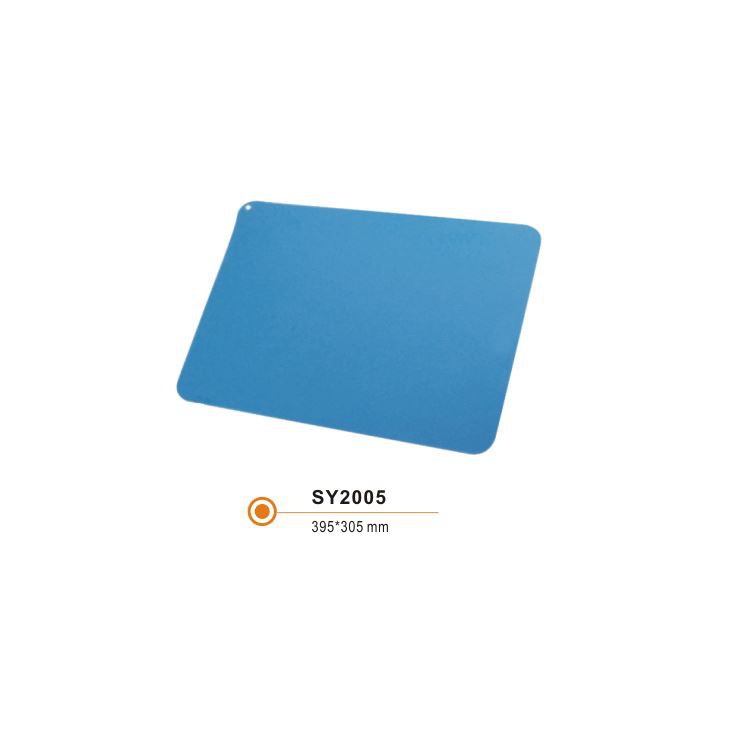

If we assume a square silicone cup mat with an original side length $L_0 = 10$ cm, and $\Delta T=35 - 20 = 15$°C, and $\alpha = 300\times10^{- 6}$ /°C. Then $\Delta L=10\times300\times10^{-6}\times15 = 0.0045$ cm. This expansion is quite minimal and likely won't be noticeable to the naked eye.
On the other hand, if you put a hot cup directly on the silicone cup mat, it's a different story. A freshly brewed cup of coffee can be around 80°C. If the initial room temperature is 20°C, then $\Delta T = 80 - 20=60$°C. Using the same $L_0 = 10$ cm and $\alpha = 300\times10^{-6}$ /°C, we get $\Delta L=10\times300\times10^{-6}\times60 = 0.018$ cm. This is still a relatively small expansion, but it could potentially be noticeable if you're observing carefully.
When the temperature drops, the silicone cup mat will contract. If the temperature falls from 20°C to 5°C ($\Delta T=-15$°C), the change in length will be $\Delta L = 10\times300\times10^{-6}\times(- 15)=-0.0045$ cm.
Factors Affecting Expansion and Contraction
It's important to note that the actual expansion and contraction of silicone cup mats can be affected by several factors. The formulation of the silicone matters a great deal. Different manufacturers may use different additives in their silicone mixes, which can alter the CTE. For example, adding fillers like silica can reduce the CTE of the silicone and make it more stable in terms of thermal expansion.
The thickness of the cup mat also plays a role. A thicker cup mat may experience more expansion or contraction than a thinner one because there is more material volume that is affected by temperature changes. Additionally, the shape of the cup mat can influence how it expands and contracts. A more complex shape with indentations or cut - outs may expand or contract unevenly, which could affect its overall appearance and functionality over time.
Applications and Related Products
Silicone cup mats are just one part of a larger family of silicone - based kitchen products. If you're interested in more silicone items for your kitchen, I'd like to introduce you to some related products. You can check out our Silicone Baking Sheet for Cookware and Silicone Trivet for Cookware. These products share the same high - quality silicone material as our cup mats and benefit from similar thermal properties.
The baking sheet, for instance, offers excellent heat distribution and can withstand high baking temperatures, while the trivet provides a reliable surface to place hot pots and pans directly from the stove or oven.
Quality Assurance
As a supplier, we take great care in ensuring the quality of our silicone cup mats. We understand that the expansion and contraction properties are crucial to the functionality and durability of the product. Our manufacturing process adheres to strict quality control standards. We test each batch of cup mats under different temperature conditions to ensure that the expansion and contraction are within the expected range.
This not only guarantees that the cup mats will protect your surfaces effectively but also that they maintain their shape and appearance over time. We source the highest - grade silicone materials and use advanced manufacturing techniques to produce cup mats that are both practical and aesthetically pleasing.
Procurement Inquiry
If you're in the market for high - quality silicone cup mats, whether for personal use, a business such as a café or restaurant, or for resale, we're here to serve you. Our wide range of designs, colors, and sizes can meet various needs. We pride ourselves on providing excellent customer service and competitive pricing.
To start a conversation about making a purchase, simply reach out and get in touch. We'd be more than happy to discuss your requirements, provide samples, and offer detailed product information. Whether you need a small batch for a one - time event or a large order for ongoing business needs, we're ready to work with you.
References
- "Handbook of Silicone Elastomers" by Michael A. Brook
- "Polymer Materials Science and Engineering" textbooks
- Research papers on the thermal properties of silicone polymers from academic journals.